
Comal County Previous Residents Sources
Previous residents are best traced as an evidence chain. The current tax account provides an owner, a property location, an owner mailing address, and an account number. The county GIS and a recorded plat add the parcel shape and lot or subdivision context. Those details make it possible to follow the property through the County Clerk records even when an old directory uses an earlier address form. Ownership and occupancy answer different questions, so record both rather than treating either one as a complete household list.
| Source | Years It Covers | Where Held | What It Shows |
|---|---|---|---|
| County Clerk deed microfilm | 1846–1912 in listed reels | Texas State Library and Archives Commission / Clerk | Direct and reverse grantor-grantee indexes, legal descriptions, recording data |
| ROAM Official Public Records | Current start date not stated on its landing page | Comal County Clerk ROAM | Party, role, date, type, and recorded-instrument leads |
| New Braunfels directories | 1952–53, 1969, and 1975 verified | TSLAC Reference Reading Room | Address, listed household, telephone, and sometimes occupation |
| New Braunfels newspapers | 1905–1976 public digital run | Community History Archive | Obituaries, estates, social notices, advertisements, and property clues |
| Federal and CCGS census work | Federal schedules through 1950; local compilations 1850–1930 | National Archives and CCGS publications | Household at a census date, relationships, age, and birthplace context |
Start with the tax account when the address is current. For a much older house, start with the legal description and the early deed index. Directory years work as checkpoints between transfers, not proof that a person stayed continuously at one address. Note: a recorded owner may have used a different mailing address and may not have lived at the Comal County parcel.
Comal County Parcel Records First
The Comal County Tax Assessor-Collector search distinguishes Owner Address from Property Location. Owner Address is the tax correspondence destination. Property Location is the physical situs, or parcel address. The form expects a property location as a street number and street name without a street type or direction. It also accepts an account number with dashes, an owner name in Last First order, an account type, inactive-account choice, and paid or unpaid status. That distinction is useful when the address trail includes an estate, business, or owner who received mail elsewhere.
Use the County Engineer GIS route to orient the parcel against nearby roads, subdivisions, and districts. Its interactive data are informational and approximate, not a survey. The parcel and road layers can lead to a plat, but a recorded plat is the better bridge from street number to lot, block, subdivision, or metes-and-bounds description. The Clerk’s Plat Viewer provides unofficial downloads; a certified plat comes from the County Clerk.
Comal County Previous Residents Deed Trail
A deed trail can identify past owners of the same land, not every person who lived there. Copy the current owner name, account number, and legal description. In ROAM, search the current owner as grantee, the person who received the property, then locate the purchase instrument. The seller on that instrument is the grantor. Search that seller as an earlier grantee and repeat. A familiar street number may not appear in an older deed, which is why the legal description is the strongest continuity check.
- Find the current property location and account in the county tax search. Save the owner name, mailing address, subdivision, and legal description separately.
- Use the current owner as a grantee in ROAM Official Public Records. Restrict an Official Public Records search by recorded date, party role, or document type when those filters help.
- Read the purchase instrument for the seller, recording date, document or instrument number, and legal description. A plat or replat may clarify a subdivision parcel.
- Search the seller as an earlier grantee. Repeat the same comparison of legal description, not merely the name or street label.
- When the online chain stops, request a document-specific Clerk search or use the TSLAC microfilm indexes. The current ROAM landing page does not publish a full online start year.
- Grantor and grantee
- The grantor transfers an interest in land. The grantee receives that interest in the recorded instrument.
- Chain of title
- A sequence of conveyances for the same parcel, read backward from a current instrument to earlier ones.
- Legal description
- The lot, block, subdivision, survey, acreage, or metes-and-bounds language that identifies land beyond a street address.
- Criss-cross directory
- An address-arranged directory that can lead from a house number to a listed historical occupant.
Comal County Records Deed Reels
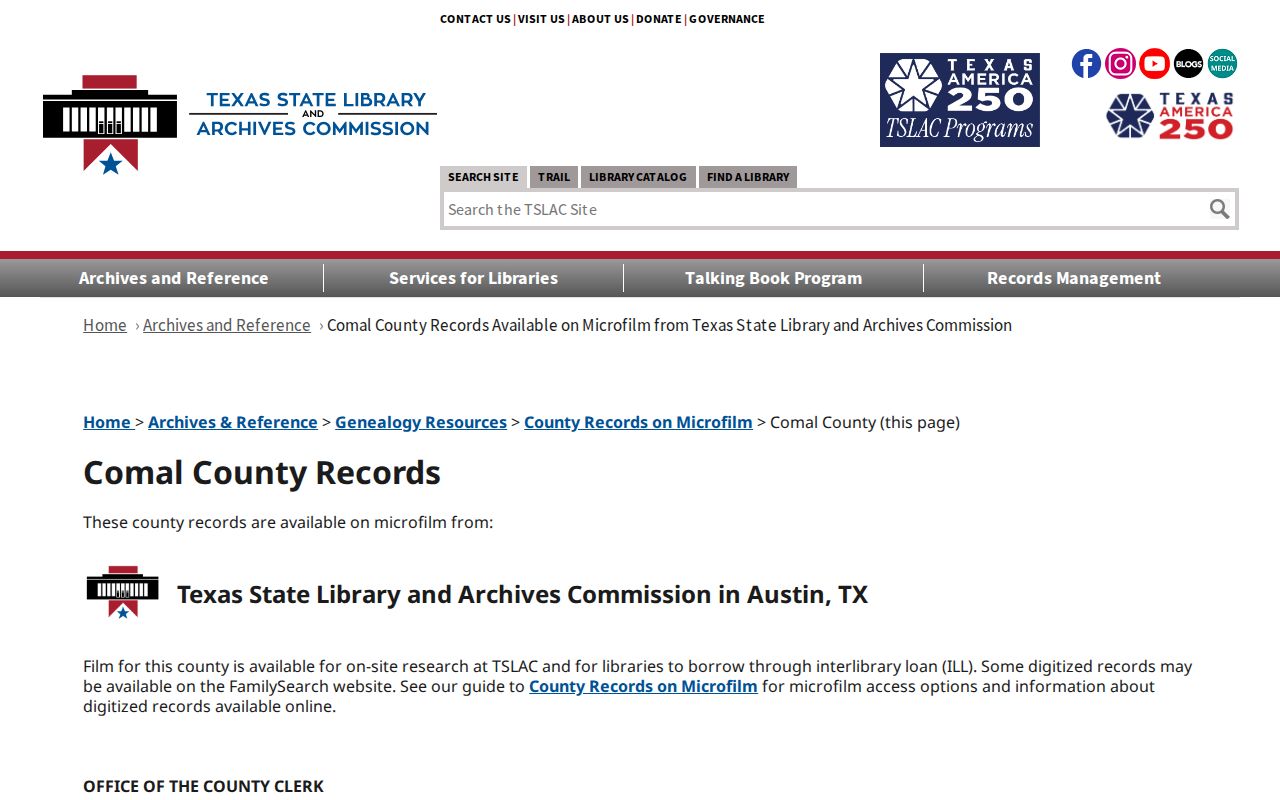
The TSLAC Comal County microfilm guide is the practical fallback when a web result is incomplete. It lists Deed Record direct indexing from 1846 to 1895 on Reel 1014953 for volumes A–H and O–W. Reel 1014954 holds reverse indexing for the same groups and a general index for volumes I–N. Reel 1750585 continues the listed deed material from 1895 to 1912. The catalog also notes that there is no Volume J, so a volume-letter gap is not by itself evidence of a lost deed.
The TSLAC catalog page shows the direct and reverse index table used for the Comal County previous residents trail.
The reel listings provide a tangible next step when a modern index cannot establish an older ownership link. Deed-of-trust records are a separate series, and the catalog notes an unindexed Volume 3 for part of that run.
Comal County Address Continuity
Old address forms deserve their own research note. Comal County Order 411 permits the Address Coordinator to correct duplicate or out-of-sequence numbers and odd-even conflicts. It also provides rules for apartment and suite numbering. A house can therefore be the same parcel while its current USPS-style address differs from a historical directory or newspaper spelling. Keep an old form, current form, nearest cross streets, subdivision and lot or block together in a research log.
New subdivisions complicate the trail in another way. A plat may appear before an address is well represented in printed directories. For a new development, record the recorded plat, its revisions, the location category, and current GIS context. For a much older property, use old street names with the newspaper archive, reverse directory, and deed legal description before deciding that two differently numbered results refer to different places.
Comal County Previous Residents in Directories
Past residents emerge most clearly when a deed chain is paired with address listings. TSLAC verifies New Braunfels city-directory entries for 1952–53, 1969, and 1975. The UT Briscoe Center also identifies a Polk regional run for 2001 through 2004 and catalogs New Braunfels city, telephone, and community titles. Check the alphabetical entry, then the reverse or criss-cross section if the volume has one. A listed name, spouse notation, address, telephone, occupation, or owner mark is evidence for that edition only.
The historical volumes themselves are described in more depth in the Comal County city directory collection guide. On a house-history search, use that shelf as a date-and-address checkpoint rather than trying to read it as a modern resident roster. The New Braunfels Public Library can help locate telephone books, yearbooks, local-history items, and additional directory holdings not listed on its public site.
UNT’s City Directories collection offers search and browse controls for digitized directory material.
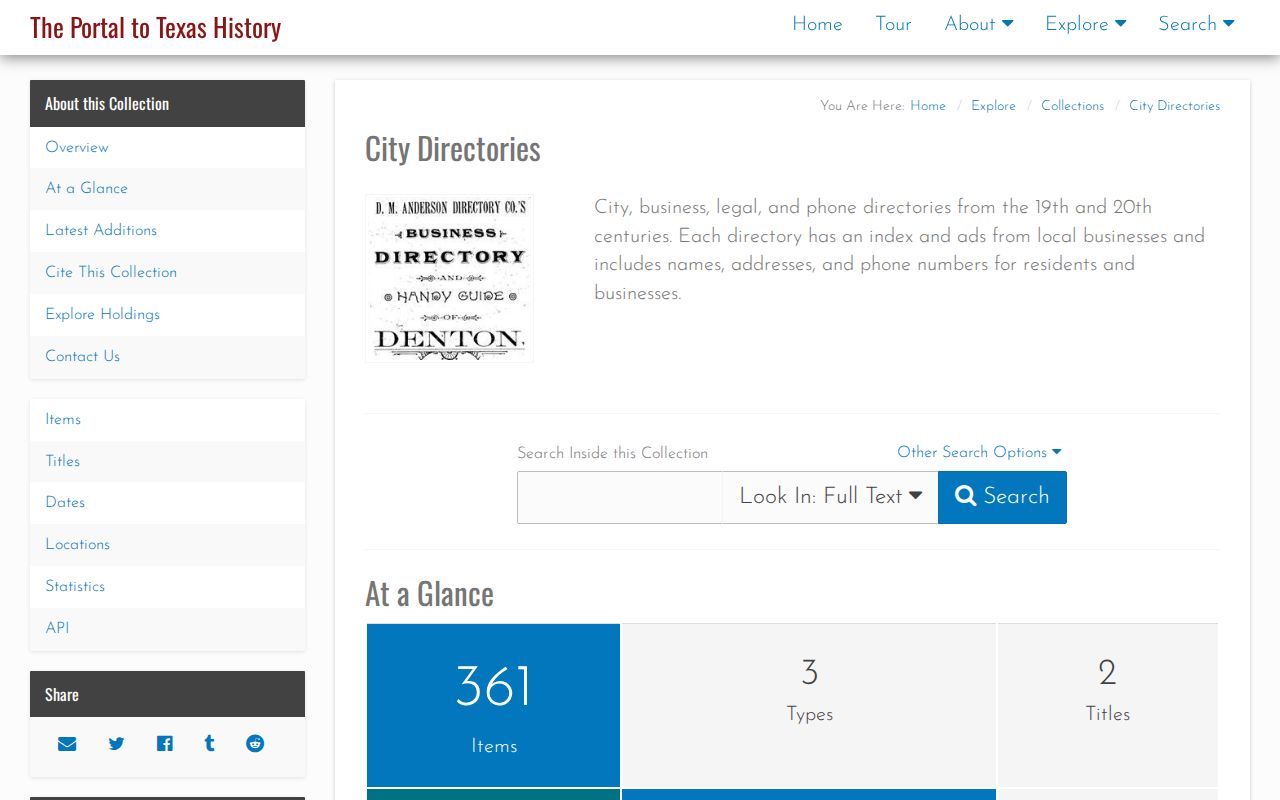
Digitized material can surface a spelling or address lead, while the TSLAC and Briscoe holdings establish the verified New Braunfels directory checkpoints and repository route.
Comal County Census Pairing
Use a directory year to choose a census comparison, not to replace one. Start with the directory surname and address. Capture the spelling, household notation, occupation, and phone if present. Search a nearby released federal census year, then compare age, relationships, birthplace, and the neighborhood against the directory clue. CCGS publications provide local census compilations from 1850 through 1930, including a reconstructed 1890 compilation. That reconstruction is a finding aid, so it should be checked against deeds, newspapers, church records, probate material, or original schedules where available.
- Fix the address and a directory year before looking for a household.
- Record the exact printed name and any spouse, occupation, or status abbreviation.
- Compare it with the nearest released census and the CCGS local index.
- Move a directory edition forward or backward, allowing for a move, skipped volume, or changed address.
- Use a deed or probate record to test whether the household and parcel belong to the same family.
Comal County Newspapers and Archives
The New Braunfels newspaper archive is a strong bridge across a directory gap. Its public digital run covers 1905–1976 and includes the Herald, Herald and Zeitung, and Zeitung Chronicle titles. Search a surname with a street, business, church, estate, or community term, then inspect the page image instead of relying only on OCR. German and Anglicized surname variants are especially important in Comal County because of the local German-Texas record trail.
Sophienburg Museum and Archives holds photographs, documents, maps, genealogy resources, oral histories, cemetery records, church material, and family histories. Its archive visits are by appointment Tuesday through Saturday, and fees apply. That collection can add neighborhood context when a tax account and deed chain do not explain how a household used a property.
Sophienburg’s archive page describes the local holdings available for Comal County previous residents and house-history research.

Archives and newspapers help explain a household’s local ties, but neither one should override the Clerk record when a title question requires a recorded instrument.
Comal County Previous Residents Endpoints
An obituary, cemetery entry, or probate file can close a past-residents trail. The New Braunfels cemetery search covers New Braunfels Cemetery and Comal Cemetery, while CCGS publishes a Comal Cemetery compilation for 1873–2001. Probate records can identify a decedent, fiduciary, heirs, and public filings. Search the County Court at Law summary for a case lead, then use the clerk for copies or inspection because online results may show actions and summaries rather than document images.
Use these sources carefully. A burial or obituary is an end-of-life clue, not a statement that a person lived at the house on the date of death. Likewise, a probate address can be a correspondence address. Match the event date, spouse or heir names, and the parcel’s deed chain before joining records into one Comal County household history.
Comal County Previous Residents Limits
Public records do not create a complete list of everyone who ever occupied a house. The tax and deed systems mainly document ownership and filings. Directories are selective and date-specific. People who did not own land, were not listed, or were protected by a confidentiality rule may be absent. Recent vital records, protected voter information, DMV data, sealed court material, and confidential program addresses are not ordinary household-search sources.
Lawful use. Comal County previous residents research is appropriate for family history, estate matters, and learning a property’s past. Do not use records to watch, threaten, stalk, or harass a living person.
When a fact needs legal proof, request the certified or official copy from the responsible custodian. The County Clerk’s written request form asks for details such as document number, volume or page, date, party names, and legal description. Broad requests for every possible filing are not a substitute for a focused record search.