
Comal County City Directory Shelves
Comal County historical-directory research is centered on New Braunfels, but the useful shelf is spread across repositories. The Texas State Library and Archives Commission, usually called TSLAC, lists a small verified run for New Braunfels. The University of Texas Briscoe Center supplies publisher and title detail for city, telephone, and regional volumes. The New Braunfels Public Library adds newspapers and local-history assistance when a directory year is missing. Treat each collection as a dated source with its own access rules, not as a complete list of county residents.
| Collection | Years | Where Held | Access |
|---|---|---|---|
| TSLAC New Braunfels listings | 1952-53, 1969, 1975 | TSLAC Reference Reading Room | On site in print or microform |
| Seguin-San Marcos-New Braunfels directory | 2001-2004 | UT Briscoe Center | Catalog and collection request route |
| Direct New Braunfels city-format title | Years not displayed in the browse record | UT Briscoe Center | Citation and holdings inquiry |
| New Braunfels newspaper archive | 1905-1976 public run | New Braunfels Public Library archive | Free search and page browse |
TSLAC says these volumes are used in the Austin reading room. Staff do not perform directory searches by phone or send scans by email, so a visit or a library-mediated alternative may be necessary. The local library can help locate telephone books, yearbooks, obituary files, and catalog material, but its public site does not publish a complete directory shelf list. Call before a trip and ask for the local-history or genealogy contact.
Note: A missing year in a displayed catalog is a reason to check another repository, not proof that no local directory was printed.
Verified New Braunfels Directory Years
The most dependable starting dates are the years TSLAC publishes in its city-by-city list: 1952-53, 1969, and 1975. Those dates establish a minimum verified run for New Braunfels. They do not establish that every other year is absent. The Briscoe Center identifies a separate regional Polk title for May 2001, April 2002, April 2003, and April 2004. Start with the date closest to a known life event, then move backward and forward one available volume at a time.
A short run is still useful. A move from one street to another can narrow a deed search, and a spouse notation can help separate two people with the same surname. If a household vanishes, test several ordinary explanations: a move, a different spelling, a changed telephone listing, or a year that has not been located. Do not turn a gap in the collection into a conclusion about a family.
- 1952-53: TSLAC lists a New Braunfels directory for this combined year.
- 1969: TSLAC lists a separate New Braunfels volume.
- 1975: TSLAC lists another separate New Braunfels volume.
- 2001-2004: the Briscoe inventory identifies annual regional Polk citations.
See the UT Briscoe Center's New Braunfels directory inventory before requesting a title. The inventory distinguishes publication types, which helps avoid treating a telephone book as though it had the same detail as a city volume.
The source inventory is shown in the Briscoe Center directory browse record.
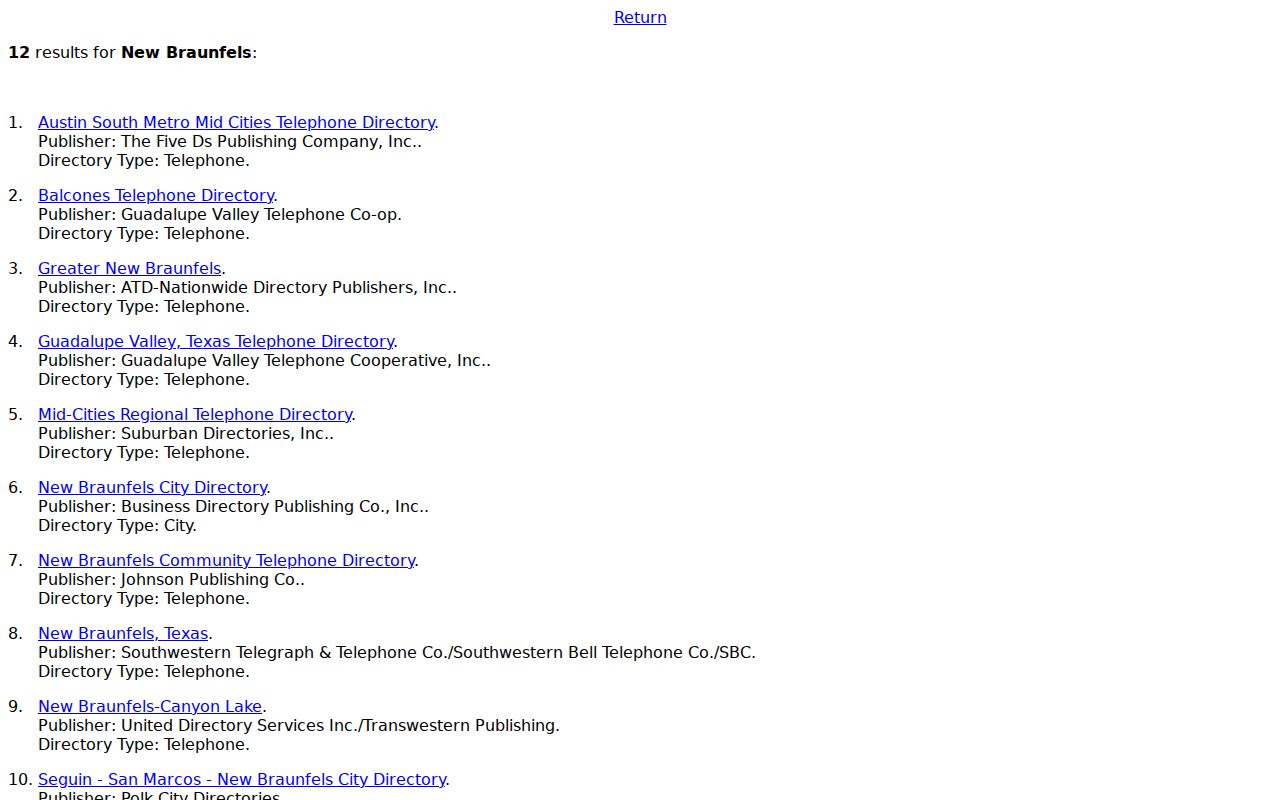
The inventory makes the city, telephone, and regional categories visible before a researcher commits to a request.
Comal County City Directory Publishers
The Briscoe Center lists twelve New Braunfels-related directory records. Business Directory Publishing Co., Inc. appears with the direct New Braunfels title, while Polk City Directories appears with the regional Seguin-San Marcos-New Braunfels title. Those are city-oriented publications, while several other entries are telephone or regional directories. The distinction matters because the kinds of fields a volume can offer are different.
Telephone listings in the inventory include Greater New Braunfels from ATD-Nationwide Directory Publishers, the New Braunfels Community Telephone Directory from Johnson Publishing Co., and New Braunfels, Texas from Southwestern Telegraph and Telephone, Southwestern Bell, and SBC. Guadalupe Valley and New Braunfels-Canyon Lake titles expand the geographic reach. A telephone directory can bridge an address or number gap, yet it may not carry the household clues available in a fuller city-format volume.
The publisher list also tells a story about the area's changing service territory. Regional titles can cover a New Braunfels household beside Seguin, San Marcos, Canyon Lake, or another nearby community. Record the exact title and date in research notes. That simple habit prevents one title's coverage area from being mistaken for the boundary of Comal County.
Note: The Briscoe browse record names publishers and types, but it does not supply an exact year run for every title.
Reading Comal County City Directory Entries
A Comal County city directory entry should be read as several small facts, each tied to the year printed on the title page. TSLAC describes common directory fields as a name, address, telephone number, and spouse name. Some volumes add an occupation or an owner or occupant notation. The exact mix varies by publisher and year. Photograph or transcribe the volume's abbreviation key before interpreting a short mark beside a name.
Older New Braunfels names deserve extra care. The local record trail includes German-language newspapers and translated church materials, so a given name or surname can appear in an anglicized form, a German form, or an imperfect optical-character-recognition result. Compare the root surname and nearby household details. A street address or spouse clue is usually stronger than a bare name match.
| Name | Usually surname followed by a given name or initials; spelling can vary. |
|---|---|
| Household clue | A spouse may appear in parentheses or in a separate entry; older books may identify a widow or widower. |
| Address | A residence and a business address may be separate in earlier volumes. |
| Telephone | A number or exchange can bridge a year without a local volume. |
| Status mark | Some books use an owner or occupant abbreviation; confirm it in that volume's key. |
- Criss-cross directory
- A reverse section arranged by street address or phone number rather than surname. It can supply an address-to-name lead.
- Householder index
- An alphabetical listing focused on the named household contact. It is not proof of every person at the address.
- Abbreviation key
- The publisher's legend for shortened words and symbols. Read it before assigning meaning to a notation.
Comal County City Directories and Telephones
These historical books and telephone directories overlap, but they answer different questions. A city volume may combine alphabetical, street, and classified material and may include a spouse, occupation, or notation beside the name. A telephone volume tends to emphasize subscriber and number information. A reverse or criss-cross book turns the order around, beginning with an address or telephone number and producing a dated occupant lead.
No authoritative New Braunfels reverse-directory year run was published in the sources inspected. The practical path is the New Braunfels Public Library catalog, TSLAC microform holdings, WorldCat, and the Briscoe Center. Ask whether a specific title has an address section rather than assuming it does. For a modern parcel or deed trail, use the Comal County street directory route instead of stretching a historical listing beyond its date.
A listed address is evidence of a publication-year association. It is not a survey boundary, a deed, or proof that a person remained at that location after publication.
New Braunfels Archives Between Directory Years
When a directory year is missing, the New Braunfels Community History Archive can supply a local bridge. Its public digital run totals 46,758 pages from 1905 through 1976: the New Braunfels Herald, New Braunfels Herald and Zeitung, and New Braunfels Zeitung Chronicle. The archive permits title and decade browsing as well as page-level searching. A surname, street, business name, estate notice, church event, or social-column item can put a household into a narrower period.
The newspaper lineage is a useful local records story. New Braunfels began with the German-language Neu-Braunfelser Zeitung in 1852, and later Herald titles reflect a German-English transition. Search alternate spellings and inspect the scanned page after an OCR result. OCR is a finding aid, not a final reading, especially where old type or a German name produces a weak match.
The TSLAC city-directory list is the source for the verified New Braunfels dates.
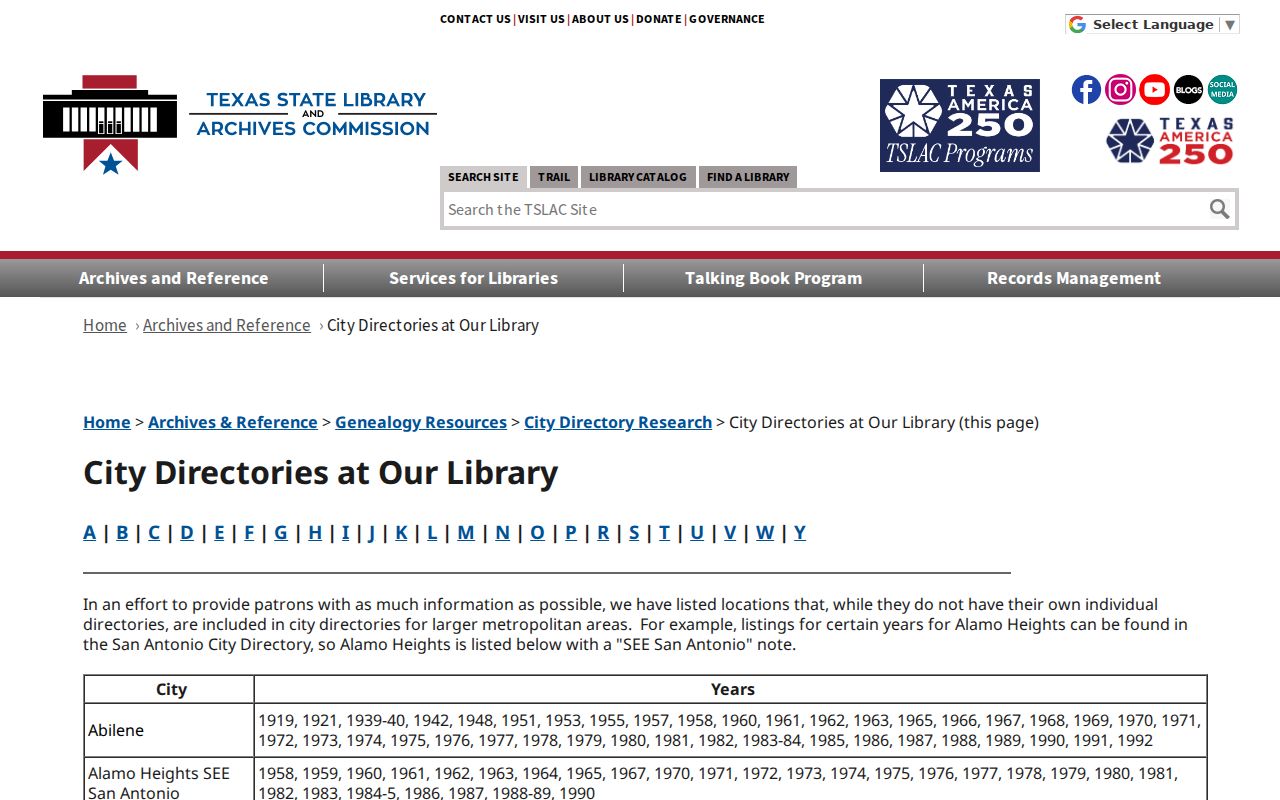
The state list provides a clear starting point for a dated directory search, while the newspaper archive fills some of the intervals.
Later Herald-Zeitung pages and several related digital resources are available through the library rather than the public archive. The library also reported in-library historical pages and genealogy databases, but access can change. Confirm availability with the New Braunfels Public Library before relying on a later year.
Note: Newspaper notices can identify a date or relationship, but a notice should be checked against the underlying clerk, cemetery, or probate record when available.
Comal County Names Beyond a City Directory
The Comal County Genealogy Society, or CCGS, offers a strong local index when the available shelf is thin. Its publications index reported 115,992 entries during the research inspection, including 76,471 in Family Footsteps. Other named groups include local census compilations, The First Founders, and Schoolhouses in the Hills. These are secondary indexes and publications, not official certificates, but they point to a source and page number that can extend a household trail.
The index offers surname or topic browsing, a given-name or sub-topic field, and Exact Match or Starts With choices. Those controls matter when a New Braunfels surname has a German, anglicized, or abbreviated form. CCGS publications include local birth and death compilations, naturalization, probate, census, cemetery, and school-community material. The society's Comal Cemetery compilation covers burials from 1873 to 2001 and reports more than 8,000 listings.
Use the CCGS publications index to record a publication and page reference, then seek the cited book, original record, or local repository. Sophienburg Museum and Archives is another local-history fallback with photographs, maps, church material, oral histories, and family records available by appointment.
Tracing a Comal County City Directory Household
Start a household trail with one directory date that can be tied to a known person, address, spouse, or telephone number. Copy the entry exactly, including its punctuation and abbreviations. Then compare the next available date rather than jumping across a decade. An address change can lead to a recorded deed, a newspaper item, a probate file, or a census household. A stable address can also help distinguish two people who share a name.
- Locate the closest verified volume and record the title, year, page, spelling, address, and every notation.
- Check the next earlier and later available New Braunfels or regional volume for an address, spouse, telephone, or name change.
- Search the street or address section only when the volume actually includes one, and treat a reverse listing as a dated lead.
- Pair the directory years with released federal census schedules and the CCGS local census compilations to test household members and ages.
- Use the newspaper archive, cemetery resources, probate index, or clerk records to explain a move, death, or estate transition.
Federal census schedules are generally released after 72 years, so directories often bridge the years between census enumerations. The CCGS reconstructed 1890 Comal census is especially useful as a finding aid, but it is not a surviving federal schedule. For a later identity question, compare the historical trail with a current official record through the Comal County resident lookup workflow.
Comal County City Directory Limits
A dated historical volume captures a publisher's listing for one edition. It cannot establish a continuous stay, prove ownership, identify everyone in a household, or confirm a present residence. Telephone volumes can leave out people without service. A listing can also use a mailing, business, or old physical address. For property questions, compare the historical address with the parcel, legal description, and recorded deed held by the Comal County Clerk.
Respect the difference between historical research and present-day contact information. Do not copy a historic listing into a claim about a living person's location. Recent vital records, protected voter addresses, sealed court material, adoption information, and Address Confidentiality Program information may be unavailable by law. A person who is absent from an index is not necessarily absent from Comal County.
Use local records for family history, estate and heir work, civic research, or a documented property question. If a record appears wrong, contact the custodian that created it. Public information must never be used to stalk, harass, intimidate, or harm anyone.